The numpty nerd blog has posts on the following-
Globalisation and localisation- Glocalisation
http://www.dailymotion.com/video/xz35gk_corporate-glocalisation_school video clip
http://www.dailymotion.com/video/xqnl87_organic-glocalisation-food-in-britain_school video clip
Cultural diffusion- with a very interesting clip on TCKs (third culture kids)
https://vimeo.com/41264088 vimeo vid clip
Third Culture Kids
Third culture kid (TCK, 3CK) are a cultural group that have grown in size in an increasingly globalised world. Sometimes referred to as cultural chameleons or global nomads, TCKs are examples of people that are affected by the process of global diffusion and the way cultures can behybridised.
Where is home? A simple question for most may be a difficult question to answer if you are living in a third culture that is detached from a specific place.
International airports are places that are sometimes associated with TCKs.
Globalisation and fashion- interesting clip on the clothing we wear today
http://www.dailymotion.com/video/xyx7pc_do-we-all-dress-the-same-way-now_school
Globalisation and food-
http://www.numptynerd.net/globalisation-food.html interesting clip on 'whopper virgins' the team have looked to find people who have never eaten a whopper to see if they like it.
http://www.numptynerd.net/globalisation-sport.html A good look at the globalization of sport
http://www.numptynerd.net/london-the-capital-city-of-the-world.html looks at Londons ethnoscape
Monday, 30 March 2015

Sunday, 29 March 2015
Ulan Ude: Cultural crossroads in Siberia
The capital of the Republic of Buryatia mixes Soviet and Buddhist styles in its architecture
The main group are the Buryat- Buddhist Russians.
The main group are the Buryat- Buddhist Russians.
Cultue in North Korea-
Some 'facts' from USA today.....
The founder of North Korea, first president Kim Il Sung, created the country's policy of JUCHE or "self-reliance," which has essentially cut off North Korea economically and diplomatically from the rest of the world even in times of great need such as famines.
Only military and government officials can own motor vehicles.
150-200,000 citizens live in prison camps, political prisoners account for 40% and whole families may be locked up, They are made to do 'hard labour' and many die from malnutrition- power phrased from USA today- source- amnesty international 2011.
North Koreans must abide by one of 28 approved haircuts. Unmarried women must have short hair, but married woman have many more options. The hair of young men should be less than 2 inches long, older men can go as long as 2¾ , according to a Taiwanese website WantChinaTimes.
All legal televisions are tuned to state-controlled domestic programming. The Internet does not exist other than a closed domestic network. Cellular 3G access is allowed to foreigner visitors. Few North Koreans know anything about world events apart from how they are described by North Korean propaganda.
The border between North Korea and South Korea is one of the most militarized in the world, according to the State Department. Pyongyang has about 1.2 million military personnel compared with 680,000 troops in South Korea, where 28,000 U.S. troops are also stationed. Nearly 6 million North Koreans are reservists in the worker/peasant guard, compulsory to the age of 60. (meaning if needed they can be called upon to join the army in times of war/ conflict).
The World Food Programme estimates that 6 million of North Korea's 25 million people are in need of food aid and one-third of children are chronically malnourished or stunted. Although ethnically the same- North Koreans born after 1950 are on avg, 2 inches shorter than South Koreans.
Nearly all property belongs to the state. A modern independent judicial system does not exist. Religious freedom does not exist.
Foreign investment in North Korea reached $1.4 billion in 2010, according to the United Nations Conference on Trade and Development. European and Chinese companies have opened casinos for tourists and invested in mines for copper, nickel, zinc, iron and gold. Mineral reserves are estimated to be worth $6 trillion, says South Korean state mining company Korea Resources.
North Korea has a network of informants who monitor and report to the authorities fellow citizens they suspect of criminal or subversive behaviour. Unauthorized access to non-state radio or TV broadcasts is severely punished.
From BBC article- 2011-
North Koreans are well educated and many speak good English, there are many English teachers working in the country and the son of the former leader was educated in the UK (university level)
Students say they admire other leaders like Mao and Stalin, but haven't heard of Mandela.
Presidents receive 'immortality' status, residents still refer to dead previous president as 'the president', The capital city Pyongyang has more than 50 statues of him (despite death in 1994).
About 3,000 people 'leave/ escape' North Korea into the south each year, they have to spend time in a special education programme to learn about life in the 21st century (South Korea is one of the most technologically advanced nations in the world- there are computers and cameras in the shopping areas to send images to friends and they are better connected by broadband than any other nation)
https://www.youtube.com/watch?v=-mDoYbC3uGs Unreported World China & North Korea The Great Escape, Documentary 2009.
NK is not connected to the WWW, they have an internal intranet only. Mobile phone calls cannot contact outside world (legally).
Tourism is allowed but the areas they can see are limited and a guide must be present.

NK has named flowers after its 2 former presidents- "Kimjongilia" and the "Kimilsungia".
Haircuts-
from the guardian 2014-


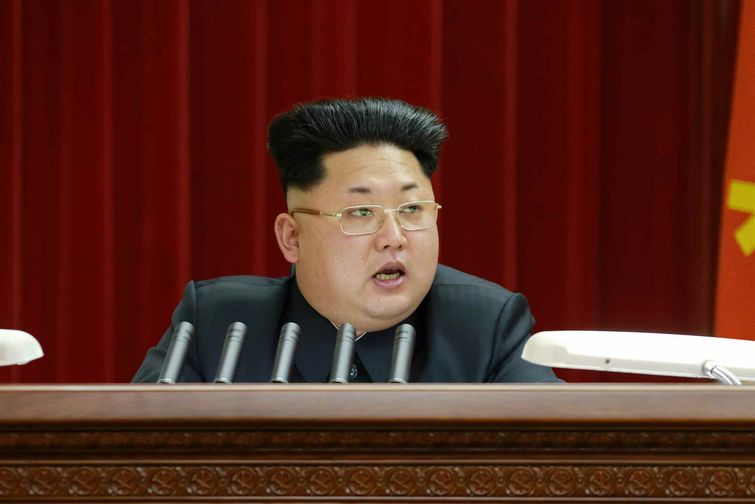
The leader in 2015
Western education in Pyongyang- https://www.youtube.com/watch?v=ur7IwW5NA0s BBC panorama programme- Educating North Korea

There are 500 male students, handpicked by the regime (most sons of current govt officials). They attend the university on the city edge and attend lectures in English- often from English/ American lecturers.
The uni was funded by Korean and US Christian charities (the practicing Christianity is illegal in NK)
A military school in North Korea- BBC video clip 2013
Undercover in NK- a BBC clip 2013
https://www.youtube.com/watch?v=2zDYrFE985g Youtube 30 minute BBC panorama programme from 2013.
Educational programme brings foreigners to North Korea- BBC article 2011
The founder of North Korea, first president Kim Il Sung, created the country's policy of JUCHE or "self-reliance," which has essentially cut off North Korea economically and diplomatically from the rest of the world even in times of great need such as famines.
Only military and government officials can own motor vehicles.
150-200,000 citizens live in prison camps, political prisoners account for 40% and whole families may be locked up, They are made to do 'hard labour' and many die from malnutrition- power phrased from USA today- source- amnesty international 2011.
North Koreans must abide by one of 28 approved haircuts. Unmarried women must have short hair, but married woman have many more options. The hair of young men should be less than 2 inches long, older men can go as long as 2¾ , according to a Taiwanese website WantChinaTimes.
All legal televisions are tuned to state-controlled domestic programming. The Internet does not exist other than a closed domestic network. Cellular 3G access is allowed to foreigner visitors. Few North Koreans know anything about world events apart from how they are described by North Korean propaganda.
The border between North Korea and South Korea is one of the most militarized in the world, according to the State Department. Pyongyang has about 1.2 million military personnel compared with 680,000 troops in South Korea, where 28,000 U.S. troops are also stationed. Nearly 6 million North Koreans are reservists in the worker/peasant guard, compulsory to the age of 60. (meaning if needed they can be called upon to join the army in times of war/ conflict).
The World Food Programme estimates that 6 million of North Korea's 25 million people are in need of food aid and one-third of children are chronically malnourished or stunted. Although ethnically the same- North Koreans born after 1950 are on avg, 2 inches shorter than South Koreans.
Nearly all property belongs to the state. A modern independent judicial system does not exist. Religious freedom does not exist.
Foreign investment in North Korea reached $1.4 billion in 2010, according to the United Nations Conference on Trade and Development. European and Chinese companies have opened casinos for tourists and invested in mines for copper, nickel, zinc, iron and gold. Mineral reserves are estimated to be worth $6 trillion, says South Korean state mining company Korea Resources.
North Korea has a network of informants who monitor and report to the authorities fellow citizens they suspect of criminal or subversive behaviour. Unauthorized access to non-state radio or TV broadcasts is severely punished.
From BBC article- 2011-
North Koreans are well educated and many speak good English, there are many English teachers working in the country and the son of the former leader was educated in the UK (university level)
Students say they admire other leaders like Mao and Stalin, but haven't heard of Mandela.
Presidents receive 'immortality' status, residents still refer to dead previous president as 'the president', The capital city Pyongyang has more than 50 statues of him (despite death in 1994).
About 3,000 people 'leave/ escape' North Korea into the south each year, they have to spend time in a special education programme to learn about life in the 21st century (South Korea is one of the most technologically advanced nations in the world- there are computers and cameras in the shopping areas to send images to friends and they are better connected by broadband than any other nation)
https://www.youtube.com/watch?v=-mDoYbC3uGs Unreported World China & North Korea The Great Escape, Documentary 2009.
NK is not connected to the WWW, they have an internal intranet only. Mobile phone calls cannot contact outside world (legally).
Tourism is allowed but the areas they can see are limited and a guide must be present.
NK has named flowers after its 2 former presidents- "Kimjongilia" and the "Kimilsungia".
Haircuts-
from the guardian 2014-
The leader in 2015
Western education in Pyongyang- https://www.youtube.com/watch?v=ur7IwW5NA0s BBC panorama programme- Educating North Korea
There are 500 male students, handpicked by the regime (most sons of current govt officials). They attend the university on the city edge and attend lectures in English- often from English/ American lecturers.
The uni was funded by Korean and US Christian charities (the practicing Christianity is illegal in NK)
A military school in North Korea- BBC video clip 2013
Undercover in NK- a BBC clip 2013
https://www.youtube.com/watch?v=2zDYrFE985g Youtube 30 minute BBC panorama programme from 2013.
Educational programme brings foreigners to North Korea- BBC article 2011
cocacolonisation- in all but 2 countries.......
Coca Cola is only not available in 2 countries- Cuba and North Korea- over the years there have been issues- it has represented capitalism's spread around the globe- 'capitalism in a bottle'.
It is not sold in Cuba since a trade embargo was put in place against the Island in the 1962 when Fidel Castro became the countries leader. NK has had the same trade embargo since 1950.

The French coined the term- coca-colonisation, when some saw the drink as a threat to French culture. It has struggled in the Middle East (banned by Arab league 1968-91) due to being sold in Israel. It was never marketed in the Soviet Union as makers feared communists would take profits.
When the Berlin wall fell in 1991, Coca- cola was sold in bucket loads to those in the east- who had lived behind the iron curtain for years,
More recently the brand has been targeted because it is American- e.g. 2003- Thailand boycotts and people emptying bottles in streets in protest to the Iraq invasion. Sales were suspended.
The Venezuelan president Chavez has encouraged Venezuelans to drink local juices and Iran's president Ahmadinejad has tried to ban the drink.
It is not sold in Cuba since a trade embargo was put in place against the Island in the 1962 when Fidel Castro became the countries leader. NK has had the same trade embargo since 1950.
The French coined the term- coca-colonisation, when some saw the drink as a threat to French culture. It has struggled in the Middle East (banned by Arab league 1968-91) due to being sold in Israel. It was never marketed in the Soviet Union as makers feared communists would take profits.
When the Berlin wall fell in 1991, Coca- cola was sold in bucket loads to those in the east- who had lived behind the iron curtain for years,
More recently the brand has been targeted because it is American- e.g. 2003- Thailand boycotts and people emptying bottles in streets in protest to the Iraq invasion. Sales were suspended.
The Venezuelan president Chavez has encouraged Venezuelans to drink local juices and Iran's president Ahmadinejad has tried to ban the drink.
How far is globalisation impacting on North Korea?
Is globalisation even making a mark on North Korea?
There are definitely signs
This article paints a brilliant picture of NK, but its translated from German (lost messages? possible!)
It highlights the diversity there but also how elements of globalisation- phones, consumerism, alcohol are creeping in. NK now hosts 10,000 tourists a year, has its own 'Manhattan' style skyline, but also 4th biggest military (60% of GDP goes here!). There are many small holdings and only a handful of approved haircuts, clothing styles but also French perfumes on sale and goods imported from neighbouring China (legally and illegally)
There are definitely signs
This article paints a brilliant picture of NK, but its translated from German (lost messages? possible!)
It highlights the diversity there but also how elements of globalisation- phones, consumerism, alcohol are creeping in. NK now hosts 10,000 tourists a year, has its own 'Manhattan' style skyline, but also 4th biggest military (60% of GDP goes here!). There are many small holdings and only a handful of approved haircuts, clothing styles but also French perfumes on sale and goods imported from neighbouring China (legally and illegally)
Saturday, 28 March 2015
Sheikha Al Mayassa: Globalizing the local, localizing the global
An interesting look at Qatar and how they are trying to preserve their Qatar identity whilst joining the western world.
It is interestingly titled too-
https://www.youtube.com/watch?v=nItwVO9stX8
Subscribe to:
Posts (Atom)